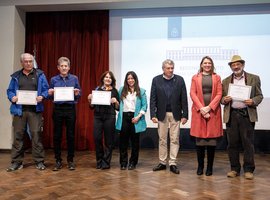
Merecido reconocimiento de la UNC a nuestros/as jubilados/as.
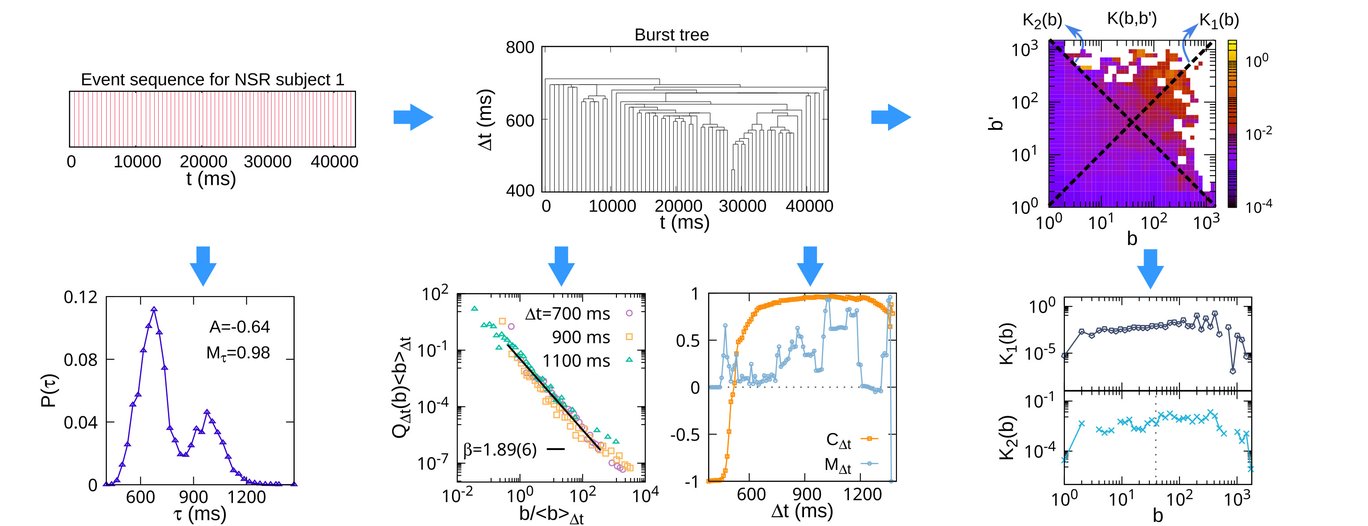
From burst tree structure to higher-order temporal correlations: Modeling and analysis of bursty time series
ayer - Aula Magna - 14:30hs Estudiantes
Complex systems, which are ubiquitous in both natural and social systems, are distinguished by their intricate networks of interactions between individual components, leading to emergent complex dynamics. These systems often exhibit bursty behaviors, where periods of intense activity are interspersed with periods of quiescence. Temporal correlations of a time series in the form of event sequences have been studied in terms of an interevent time (IET), a bursty train, and an autocorrelation function (ACF), among others. However, conventional statistical measures, such as inter-event time distributions, do not fully capture the temporal organization of bursty time series. In this talk, I will present a burst-tree decomposition framework for modeling and analyzing higher- order temporal correlations in bursty time series. First, I will discuss a kernel-based modeling approach in which burst-merging kernels determine which bursts are merged together as a timescale defining the burst increases. By considering different merging kernels, including constant, sum, product, and assortative kernels, we investigate the effect of burst-merging kernel on the higher-order temporal correlation in terms of burst-size distributions, memory coefficients for bursts, and autocorrelation functions. Our numerical results reveal that the autocorrelation function is not only depends of the kernel but also on the power law scaling exponent of the interevent time distribution. Second, I will present the time series analysis framework focused on higher-order temporal correlations in the event sequence beyond the interevent time distribution by employing the burst- tree decomposition method and its application to heartbeat time series from healthy subjects to patients with congestive heart failure and atrial fibrillation. By examining burst-related and IET statistical measures, we investigate differences in the temporal organization of heartbeat dynamics among groups. Finally, I will discuss ongoing work that combines the burst-tree structure and the visibility graphs to develop further approaches for characterizing complex temporal dynamics. Overall, this talk highlights the potential of burst-tree structure as a framework for understanding the hierarchical organization of bursts and higher-order temporal correlations in both modeled and real-world time series.
Presentador: Dr. Tibebe Birhanu
Director de Posdoc: Dr. Orlando Billoni
Referencias
Noticias

La Secretaría Académica mantiene actualizado el calendario académico, información necesaria …