
Merecido reconocimiento de la UNC a nuestros/as jubilados/as.
Modelling the X-ray Fluorescence and the detector influence: direct and inverse problem
18 Marzo 2026 - Aula Magna - 14:00hs Estudiantes
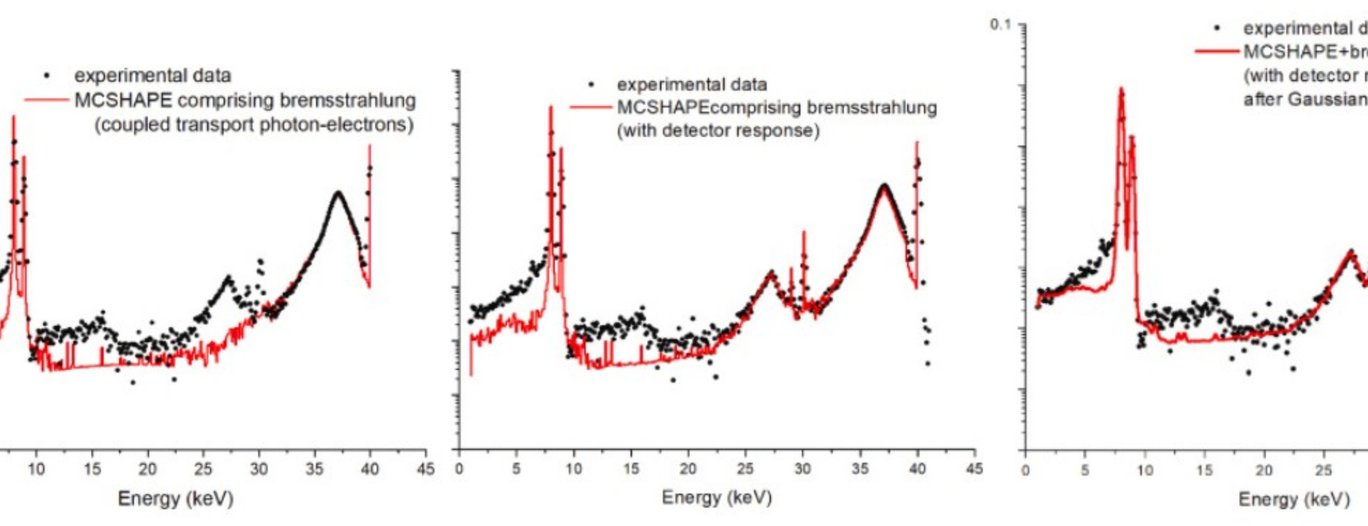
The modified Boltzmann–Chandrasekhar transport equation provides a rigorous framework for describing the photon radiation field with a complete representation of its polarization state. A proper characterization of the radiation field requires detailed knowledge of photon interactions with matter and must also include the contribution of secondary electrons through processes such as inner-shell impact ionization and bremsstrahlung, without the need to solve the coupled electron–photon transport problem. Within this framework, the theoretical X-ray emission spectrum produced by excitation with an X-ray source can be derived from the albedo solution of the transport equation. However, the spectrum measured by an energy-dispersive detector differs from the original photon spectrum due to distortions introduced by the detector and the pulse electronics. The detector response function (DRF), which describes radiation transport and energy deposition inside the detector, produces a deformation of the spectrum. In addition, statistical fluctuations in photon detection lead to asymmetric resolution broadening, while pulse electronics introduce further distortions through pulse pile-up (PPU) effects. Once the DRF and the resolution broadening are properly characterized, an accurate forward modeling of the measured spectrum can be achieved (direct problem). Conversely, the original photon spectrum can be recovered from experimental measurements through an unfolding procedure (inverse problem). This work presents the methodology implemented in a set of computer codes developed in Bologna to reconstruct the source spectrum from measured data. The procedure includes PPU correction, calculation of the combined DRF and resolution effects to generate the response matrix, and application of the UMESTRAT unfolding algorithm based on the maximum entropy method, which exploits prior information while preserving the positivity of the spectrum. Results obtained for representative solid-state detectors (Ge and CdTe) demonstrate the effectiveness of the approach.
Presentador: Dr. Jorge E. Fernandez
Laboratory of Montecuccolino-DIN, Alma Mater Studiorum University of Bologna, via dei Colli 16, 40136 Bologna, Italy
Contacto Local: Dr. Mauro Valente
Referencias
Noticias

La Secretaría Académica mantiene actualizado el calendario académico, información necesaria …